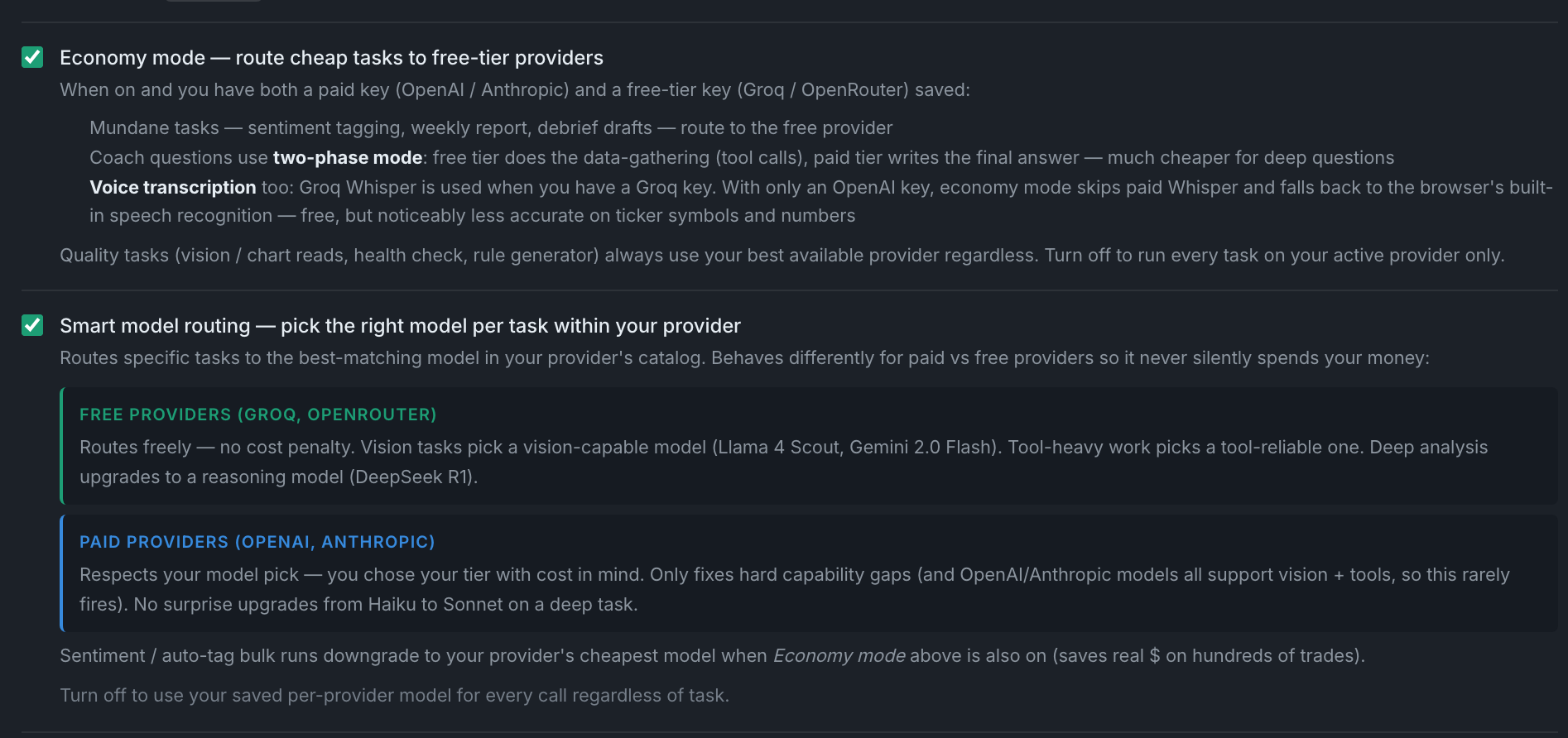
What is smart model routing and when does it pick a cheaper model?
Smart routing overrides your model choice for one call when the task needs something your model cannot do. It is on by default. On free providers it moves freely; on paid providers it only fixes hard capability gaps, so it will never quietly upgrade you from Haiku to Opus.
Features tell the app what kind of work they are asking for, and routing acts on that. There are three kinds of override and they have different rules.
Capability overrides always apply. If the task needs vision and your model cannot see, or needs reliable tool calls and your model's are unreliable, the app picks one from the same provider that can. This is correctness, not economy — the alternative is a failed call. It is the main reason Groq works well despite its default model handling neither: chart reads quietly go to Llama 4 Scout instead.
Reasoning upgrades apply on free providers only. A deep task starting from a small free model is moved up to a reasoning-capable free model — DeepSeek R1 on OpenRouter, for instance. On a paid provider this never fires: you chose your tier with cost in mind, and an upgrade you did not ask for is a bill you did not expect.
Classification downgrades apply everywhere, but only if economy mode is also on. Bulk tagging drops to the provider's cheapest model. This is the one place downgrading a paid user's choice is unambiguously right — a cheap model classifies sentiment as well as an expensive one, and the difference across hundreds of trades is real money.
Turn it off and every call uses your saved model for that provider regardless of task. The cost is that tasks your model cannot do will fail rather than reroute.