What is on the Report Card, and what are the mental scores?
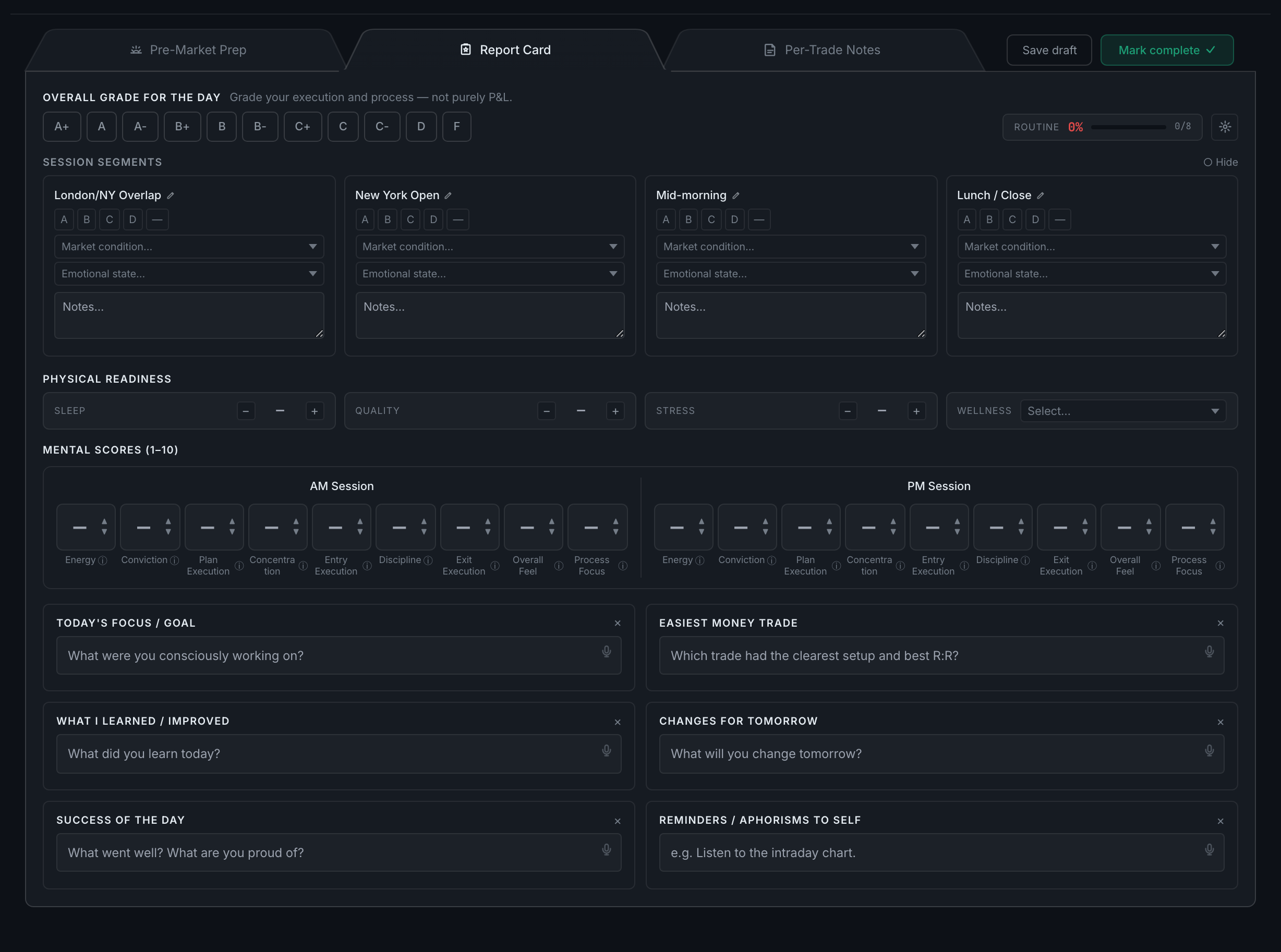
An overall letter grade for the day, nine mental scores out of ten — scored twice, once for your morning session and once for your afternoon — your physical readiness, the market conditions, and a set of written reflections. Those scores are what the entire Psychology tab in Analytics is built from.
This is the most consequential tab in the app for anyone who wants the psychology analysis to say anything, because nothing else feeds it.
The overall grade runs A+ down to F. It is what shows on the day's cell in the month grid.
The nine mental scores, each 1 to 10, each with its own definition of what 1 and 10 mean. The card lays them out in two columns — AM Session and PM Session — so a morning that went well and an afternoon that did not are recorded as two different things rather than averaged into one lie:
- Energy1 is exhausted and foggy, 10 is fully rested and sharp.
- Conviction1 is second-guessing every read, 10 is a clear high-confidence thesis.
- Plan Execution1 is outcome-obsessed with no plan adherence, 10 is fully executing your pre-defined plan.
- Concentration1 is easily distracted, 10 is locked in.
- Entry Execution1 is chasing price, 10 is patient entries at your planned level.
- Discipline1 is breaking every rule, 10 is following the plan even when uncomfortable.
- Exit Execution1 is cutting winners early and holding losers, 10 is exits that matched the plan.
- Overall FeelYour gut sense of the day mentally.
- Process Focus1 is pure P&L chasing, 10 is fully process-driven regardless of results.
Score them honestly rather than kindly. The whole value of the Psychology tab is that it correlates these against your actual results, and a column of eights teaches it nothing.
Above them sits Physical readiness — Sleep, Quality, Stress and Wellness (feeling great, normal, tired, sick, injured). These are the inputs the readiness analysis on the Psychology tab correlates against your results, so they are worth a few seconds even on a day you would rather not think about.
A Routine tracker sits beside the grade, counting how many of your eight routine steps you actually did, as a percentage. It is the only figure on the card that is not a judgement — it just counts.
Around all of it sit the day's market conditions (trending up or down, range-bound, choppy, news-driven, low or high volatility), session segments — one block per segment of your trading schedule, each with its own letter grade, market condition, emotional state and notes — and six written fields: today's focus or goal, the easiest money trade, what you learned, changes for tomorrow, the success of the day, and reminders to self.
Sections you never use can be hidden from the gear menu, so the card stays as short as you want it.