What do the numbers on a setup card mean?
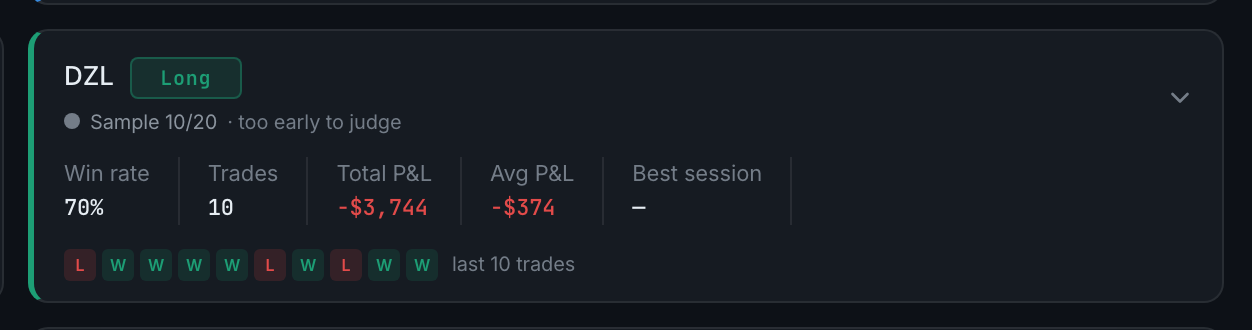
Win rate, trade count, total and average P&L, your best session and a strip of recent results — plus a coloured verdict, which only appears once the setup has 20 trades behind it.
The card reads in two parts. The line under the setup's name is the verdict, and the row beneath it is the raw numbers.
The verdict is deliberately conservative:
- No trades yetNothing has been logged against this setup.
- Sample n/20You have some trades but not enough. The card tells you how far off you are and adds too early to judge rather than showing a colour.
- Above baseline65% win rate or better, across 20 trades or more.
- On baseline50% to 64%.
- Below baselineUnder 50%.
The numbers in the row below are:
- Win rateWins as a percentage of trades on this setup.
- TradesHow many you have logged against it, all time.
- Total P&LEverything this setup has made or lost.
- Avg P<hat total divided by the trade count, which is usually the more honest figure of the two. A setup can have a fine win rate and a poor average.
- Best sessionWhatever you set when you created the setup. It is a note to yourself, not something the app measured.
- The recent runA strip of W and L for the ten most recent trades on the setup, in order, labelled with how many it is actually showing. It is the one figure on the card that moves quickly: a setup that has stopped working shows it here well before an all-time win rate notices.
Copy-traded mirrors are counted once. If one decision fires across three accounts, the count and win rate treat it as one trade while the P&L still reflects the real combined money.