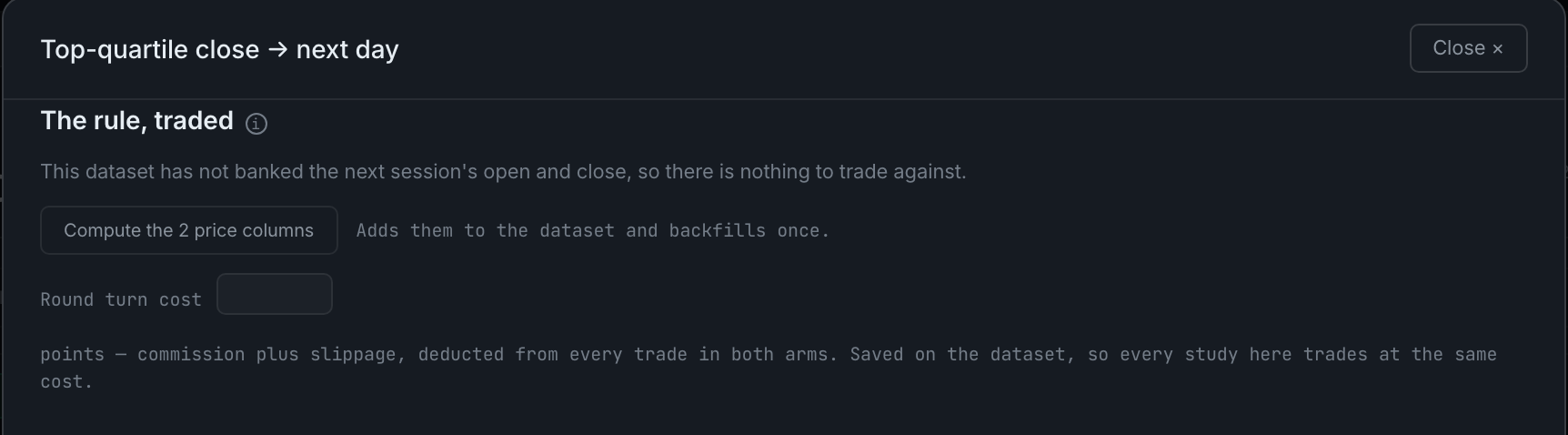
What is "The rule, traded"?
The backtest. It takes the position the next session after every signal, one unit at a time, against a control that trades every single day.
A rate is not a trade. This exhibit turns the study into one.
The rule is stated in a sentence above the table: go long or short the session after each signal, in at the open, one unit, out at the stop or target if the setup card has measured them, otherwise at the close. Both arms pay your round-turn cost.
The table has two rows that matter — Signal days and Every day — with trades, total points, average, win rate, profit factor and max drawdown. Compare the Avg column, not the totals: the two arms take very different numbers of trades, and a total that is bigger because it traded four times as often is not an edge.
Everything is in points, never dollars, because contracts and point value are position sizing and the study knows nothing about your sizing.
Three pieces of honesty built into this exhibit:
- The round-turn cost is an editable field, saved on the dataset so every study here trades at the same cost. Under it, the breakeven line: how many points of cost the rule can afford before it stops making money. A rule that averages half a point is not tradeable if a round turn costs you one.
- A best case and a worst case, when a stop and a target are set. Daily bars record the high and the low but not which came first, so a session that touched both is genuinely ambiguous. Rather than guess, the exhibit scores those sessions twice and shows both rows, tells you how many were ambiguous, and says to judge the rule on the worst case.
- The equity curve and the last ten trades, so the numbers have a face — and the curve is drawn oldest-first, because a running total that appears to count backwards is unreadable.
If the dataset has not banked the next session's open and close, there is nothing to trade against. The exhibit says so, offers to compute the two price columns it needs, and shows the round-turn cost field anyway — the cost is a setting the exhibit reads rather than a result it produces, and hiding it until the columns exist made it impossible to find.